2026 UX Tools: What Works and Why

Shiva Chavoshian
UX Researcher
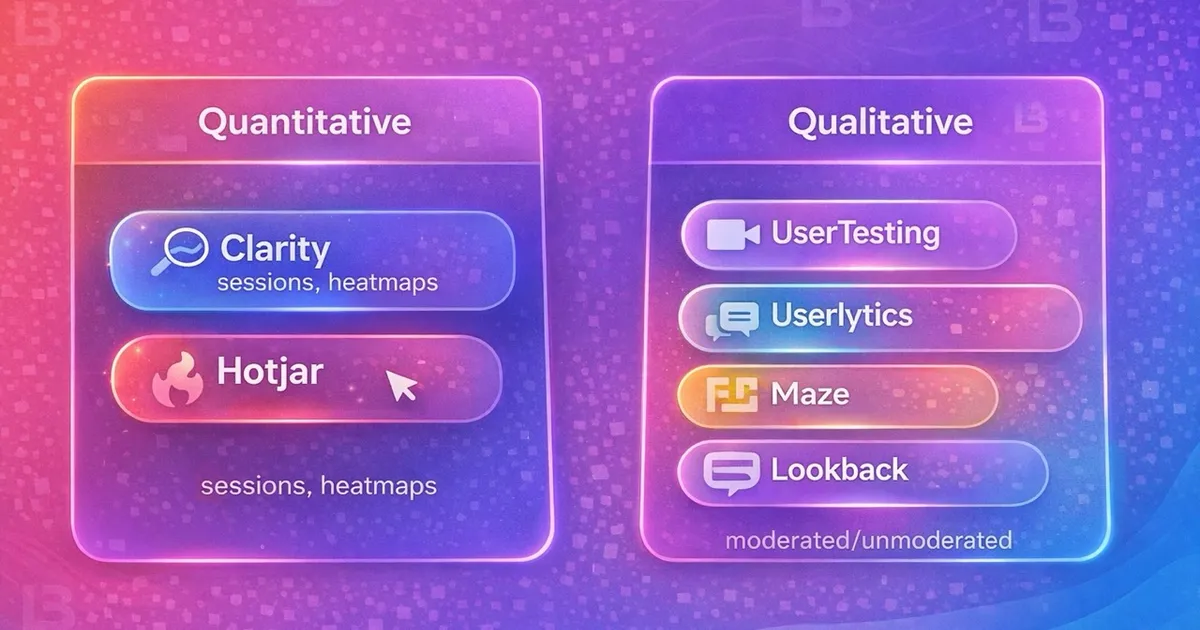
2026 UX Tools
What Works and Why
In early 2026, the world is flooded with apps. There are now over 8.9 million mobile apps across the Apple App Store and Google Play. Yet users only engage with 9–12 apps a day, and less than 30 apps per month.
So even though anyone can build an app today – thanks to AI generators, drag-and-drop builders, and rapid prototyping tools; winning users is harder than ever.
It seems,
Understanding people is harder than building
Teams that rely only on analytics and assumptions often ship products that look great but feel confusing in real life. This is exactly why UX testing is becoming the competitive edge in 2026.
Below is a simple, clear breakdown of the best UX testing tools, when to use each, and how AI fits into the research workflow.
Why UX Research Matters
(and Why Quantitative Alone Misleads)
Numbers show what users did.
But only people can tell you why they did it.
A dashboard might reveal that:
40% of users drop at Step 2
a feature is barely used
click-throughs are far below expectations
But numbers alone cannot explain the frustrations, misunderstandings, or emotional triggers behind user behaviour.
Real example:
A wellness app saw massive drop-offs during onboarding. The team assumed “too many steps.”
Moderated testing discovered the real problem: the “Skip for now” link looked like the primary action, and users accidentally tapped it thinking they were completing the process.
A simple visual fix increased completion by 22% within a week.
Quantitative data shows symptoms.
Qualitative research reveals causes.
Both are needed to make smart product decisions.
The Role of AI in UX Research
AI doesn’t replace UX researchers – it amplifies them.
Here’s how AI is reshaping research:
AI speeds up the parts that were slow
Automatic transcription of interviews
Instant sentiment analysis
Auto-tagging repeated behaviours or quotes
Highlight extraction across dozens of videos
What used to take hours now takes minutes.
AI helps find invisible patterns
AI tools can scan thousands of user statements and cluster them into themes such as:
onboarding confusion
trust concerns
feature discovery issues
This gives researchers a “map” of pain points before deep analysis begins.
AI is great at summarizing, but not interpreting emotions
AI can summarize what users said but still caannot yet replace the human ability to:
detect hesitation
understand tone
see frustration on a user’s face
judge whether a feature sparks excitement or confusion
AI accelerates research while humans in the process still add meaning, empathy, and context.
AI is a force multiplier, not a substitute
The best teams today use AI to:
analyze at scale
speed up synthesis
generate hypotheses faster
But the winning insights still come from real conversations with real people.
UserTesting vs. Userlytics
When a Task Needs Real Conversation
UserTesting (Enterprise-grade, structured studies)

UserTesting offers polished participants and fast results. It’s ideal for teams who need reliable, high-quality moderated sessions.
Best when:
Testing complex, multi-step flows
You need to ask follow-up questions live
You want clean, professional recordings
Not ideal for niche audiences, its panels skew toward experienced testers.
Userlytics (Affordable, flexible, “real-life users”)

Userlytics is often better for SMBs. Their participants feel more like everyday consumers, and their recruiting flexibility is excellent.
Best when:
You need to screen for specific behaviours (“placed a sports bet in the last 30 days”)
You want real-world reactions, not polished testers
You need both moderated + unmoderated options affordably
Screenshot suggestion:
Add a Userlytics dashboard screenshot with task completion stats + session clips.
Lightweight Tools That Punch Above Their Weight

Maze (Fast prototype testing)
Maze is perfect early in the design cycle. You upload a prototype → get quantitative insights fast.
Use Maze when:
You want to validate multiple design versions
You need directional insights within hours
Stakeholders request metrics like heatmaps or success rates
It’s fast and scalable but doesn’t replace conversation-based research.

Hotjar (Live behaviour insights)
Hotjar shines after launch, showing how real users behave in your product.
Use Hotjar when:
You want heatmaps of actual user clicks
You need session recordings of real frustration
Micro-surveys will help you ask questions at the right moment
It’s observational, not emotional still requires interviews to understand motivations.

Lookback (Best for deeper moderated testing)
Lookback feels like sitting next to a user in real time.
Best when:
You want your whole team to observe sessions
You’re testing something nuanced or emotion-sensitive
You need to see facial expressions + reactions
Great for deep insights and building empathy.
The Bottom Line: In 2026, Insight Beats Speed
AI has made building faster.
Tools have made testing easier.
But the hardest part hasn’t changed:
Understanding what real humans actually need.
Most products fail not because of technology, but because teams misunderstood their users.
The winners in 2026 will be the teams who:
blend quantitative + qualitative research
talk to real users early and often
use AI to accelerate understanding, not replace it
treat insights as a competitive advantage
In a world with 8.9 million apps, the only products that stand out are the ones that actually solve human problems.
Thanks for reading

Shiva Chavoshian
Shiva possesses a keen ability to delve into user needs, conduct insightful research, and translate those findings into effective design strategies and intuitive user journeys.
More Articles
Luminbrane
Luminbrane is a boutique consultancy firm dedicated to building digital products that last. We don't just write code; we partner with you to solve core business problems.
Whether you need deep-dive Postgres consultancy to stabilize your infrastructure, or a cross-functional team to handle Development, Design, UX, and Product Management, Luminbrane is your partner in navigating the digital landscape.
Learn More